
The textile and apparel industry around the world has
undergone dramatic change since the end of the quota system in 2004. According
to ITMF’s International Textile Machinery Shipment Statistics, investments in
new textile machinery jumped in Asia in the past 15 years both to increase and
also to upgrade production. In the past 15 years, around 90% of all new
machinery was shipped to Asia and the bulk of it to China. Next to new
investments in better machines that consume less energy and water, textile and apparel
companies also improved the livelihood of million of workers in the industry by
providing jobs, upskilling and social stability. This change is visible by
looking at the macro data like investments, employment or GDP. To see
first-hand what this development looks like and means for the people and the
environment on the ground over a period of many years, is encouraging. In the
past 13 years, I had the rare opportunity to visit different facilities of a
company in different countries and see how things evolved.
I first met Dr. John Cheh, Vice Chairman and CEO of the
Esquel Group, in 2005 when he spoke at the ITMF Annual Conference in Istanbul.
Thereafter, Esquel became one of the first Corporate Members of ITMF. From the
very beginning, Dr. Cheh saw ITMF as an opportunity to connect with like-minded
people who are passionate about improving the textile industry. Ever since, he
has been actively engaged with ITMF and in 2011 joined the Board.
From the very beginning, it was clear to me that Esquel cares
about the mark it leaves on this planet. It is a vertically-integrated textile
company with global operations fighting to make a positive impact on its
employees, the environment and society. This stems from the company’s vision of
“Making a Difference”:
“We believe that every employee has the potential to be an
agent of positive change. Our 5E-Culture — Ethics, Environment, Exploration,
Excellence and Education — forms the foundation of our approach and informs how
we make decisions.”
I have visited several of Esquel’s production facilities
in China and Vietnam. What stood out to me was the attention the company paid
to the working conditions for its employees, as well as the surrounding
environment and local communities.
In 2007, I joined the ITMF Spinners Committee to visit
cotton growing regions in China, which included a visit to the Xinjiang Esquel
Textile Company in Urumqi and its spinning facility. Esquel began its
construction of a vertically-integrated supply chain in mid-1990s when they established
their first spinning mill in Xinjiang. Along with subsequent expansions they
manage to take control of every step of the process from the very beginning,
ensure a reliable supply of premium grade cotton, and establish a strong
foundation for their development in sustainability that focuses on people,
planet, product and community. Our team was clearly impressed during the trip
and wrote in our report:
“The
factory has ‘state of the art’ imported equipment and still continues
to expand with the latest spinning, winding and doubling equipment. The
management of this factory could undoubtedly stand up to a textile mill
anywhere in the world.” (ITMF Spinners Committee Travel Report 2007,
pages 12)
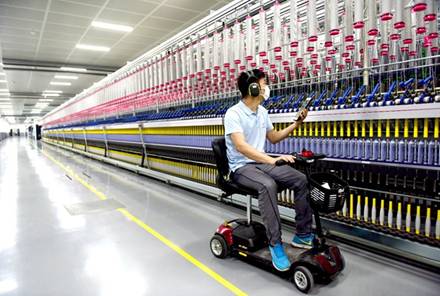
Esquel’s Spinning Mill in Changji, Xinjiang, China
During
my most recent visit to Esquel’s spinning facility in Changji, Xinjiang
in 2017, I once again had the opportunity to see a cotton spinning mill
equipped with ‘state-of-the-art’ machinery and a highly skilled staff
producing premium yarns. Esquel has made incredible progress in
automating the textile industry – at Esquel’s Changji facility, only 15
people are needed to run 10,000 spindles, compared to 50 people in a
conventional spinning mill. An important takeaway from the visit was
that Esquel’s huge investment in automation enabled them to hire and
train high-quality workers from the local community. Not only are these
employees trained and reskilled for long-term careers, but they are also
paid significantly above the minimum wage and enjoy a higher standard
of living in Xinjiang.
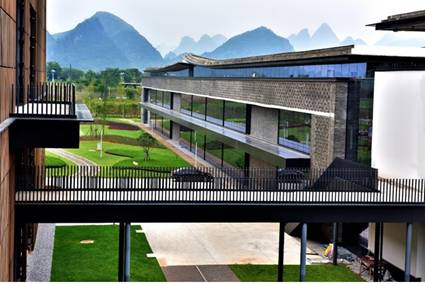
Esquel’s Spinning Mill and R&D Centre in Guilin, Guangxi, China
In
2017, I also visited Esquel’s newest production site in Guilin, Guangxi
in the southern part of China. Here, Esquel produces yarns, conducts
research on natural dyes and develops new products. It was striking to
see a textile manufacturer build a state-of-the-art production facility
in the middle of this incredibly beautiful landscape. Esquel created a
campus-like facility that in my opinion is second to none – in a
park-like area with lakes, buildings with wonderful architecture where
manufacturing facilities and the natural environment co-exist in perfect
harmony. The spinning facility is equipped with the latest technology
and automated equipment. Esquel’s facilities in Guilin are operated by a
highly skilled workforce, helping to increase the standard of living in
the region.
In the past 10 years, I have
visited Esquel’s garment manufacturing factories in Vietnam twice. Just
like the spinning mills in Xinjiang, the level of automation in these
garment facilities surpasses the industry standard. Regarding the
working conditions, it was impressive to see that the workforce not only
has an excellent working environment, but they are also constantly
encouraged to improve their skills and as a result, raise their
salaries. Over the years, the company has attained many patents, often
developed by the front-line workers, helping to increase the overall
efficiency and productivity of the facilities. The dedication to
long-term career development at these facilities continues to impress
me. They shared data with me showing that, over time, Esquel’s workers
had improved their skills and efficiency, leading to higher incomes and
reduced working hours.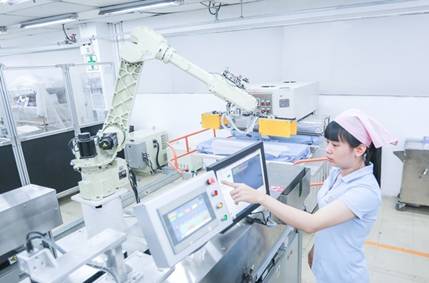
Esquel’s Garment Factory in Gaoming, Guangdong, China
Esquel
cares about local communities, and in turn local communities care about
them. In 2014, we saw this local support in action after a riot broke
out in Vietnam, affecting Esquel’s garment facility near Ho Chi Minh
City. On the second day of the riot, many Esquel workers, of their own
volition, returned to the factory with posters saying “Protect our
factory! Protect our livelihood!” This dedication to the factory caught
the attention of both national and global press, leading to immediate
help from local security forces that kept the factory safe. Such an
outpouring of support from the local employees illustrates the
appreciation they have for Esquel and their quality employment.
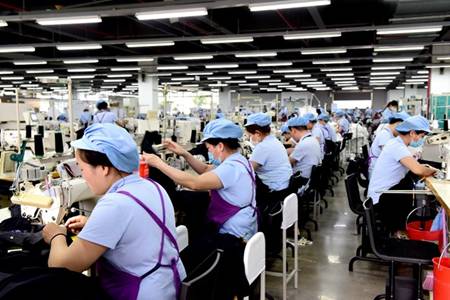
Esquel’s Garment Factory in Guilin, Guangxi, China
By
visiting any of Esquel’s facilities or attending ‘Integral
Conversation’ (Esquel’s own conference on sustainability), one could
tell that this company is not greenwashing but is working hard to reduce
continuously its environmental footprint by using cleaner dyes and
reducing water and energy consumption. This is only achievable by
working closely with sustainability partners along the entire value
chain, especially textile machinery and chemical companies. Their
wastewater-treatment facilities in Gaoming, China, has a daily capacity
to treat 38,000 tons of wastewater to standards substantially better
than regulatory requirements, and additional water-recycling process
generates 2,000 - 3,000 tons of treated water per day for reuse in
manufacturing operations.
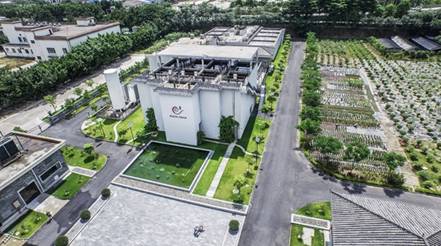
Esquel’s Water Treatment Centre in Gaoming, Guangdong, China
Since
2005, Esquel has reduced, on a per unit of output basis, consumption of
water by 67% and electricity by 49%. With investments in ‘state-of-the
art’ technology and a skilled workforce, it is possible to operate
sustainably, profitably and socially-responsibly.


 Hello, my name is Jack Sparrow. I'm a 50 year old self-employed Pirate from the Caribbean.
No comments:
Post a Comment